Getting started
See it in action
You will need:
The Undo for Java recording and replay tools (see Recording and Replay tools below).
A license key. If you don’t have a licensed copy of Undo for Java, you can obtain a free trial.
Your application or test case running under an OpenJDK or Oracle JVM on a supported Linux distribution.
To debug with an AI agent, an agent that supports MCP, such as Claude Code (see Debugging with an AI agent). To debug interactively, IntelliJ IDEA with the Undo for Java plugin (see Installing the Undo for Java plugin). You can use either or both.
Recording and Replay tools
The Recording and Replay tools are supplied as LR4J-Record-*.zip. Unzip the archive and set
LR4J_HOME to the lr4j directory it creates:
export LR4J_HOME=/path/to/lr4j
Refer to Recording an application and Live Debugging for how to use these tools. The archive also includes live-record, which records a JVM without the recording agent (see Recording with live-record).
The archive includes demo programs in $LR4J_HOME/demos/java/ that you can record and debug
to get familiar with the tools. See the
Python API example for
a worked example using these demos.
Debugging with an AI agent
Register the MCP server with your AI agent, giving it your license key file, and the agent can open and debug recordings. The MCP Server describes the setup for Claude Code, Claude Desktop and Codex, and the bundled agent skill teaches the agent the whole workflow, from making a recording to finding the root cause. See Undo for Java AI.
Installing the Undo for Java plugin
In IntelliJ IDEA Settings (Ctrl-Alt-S, or ⌘, on macOS) › Plugins › Marketplace,
search for Undo for Java, press Install and restart IntelliJ IDEA.
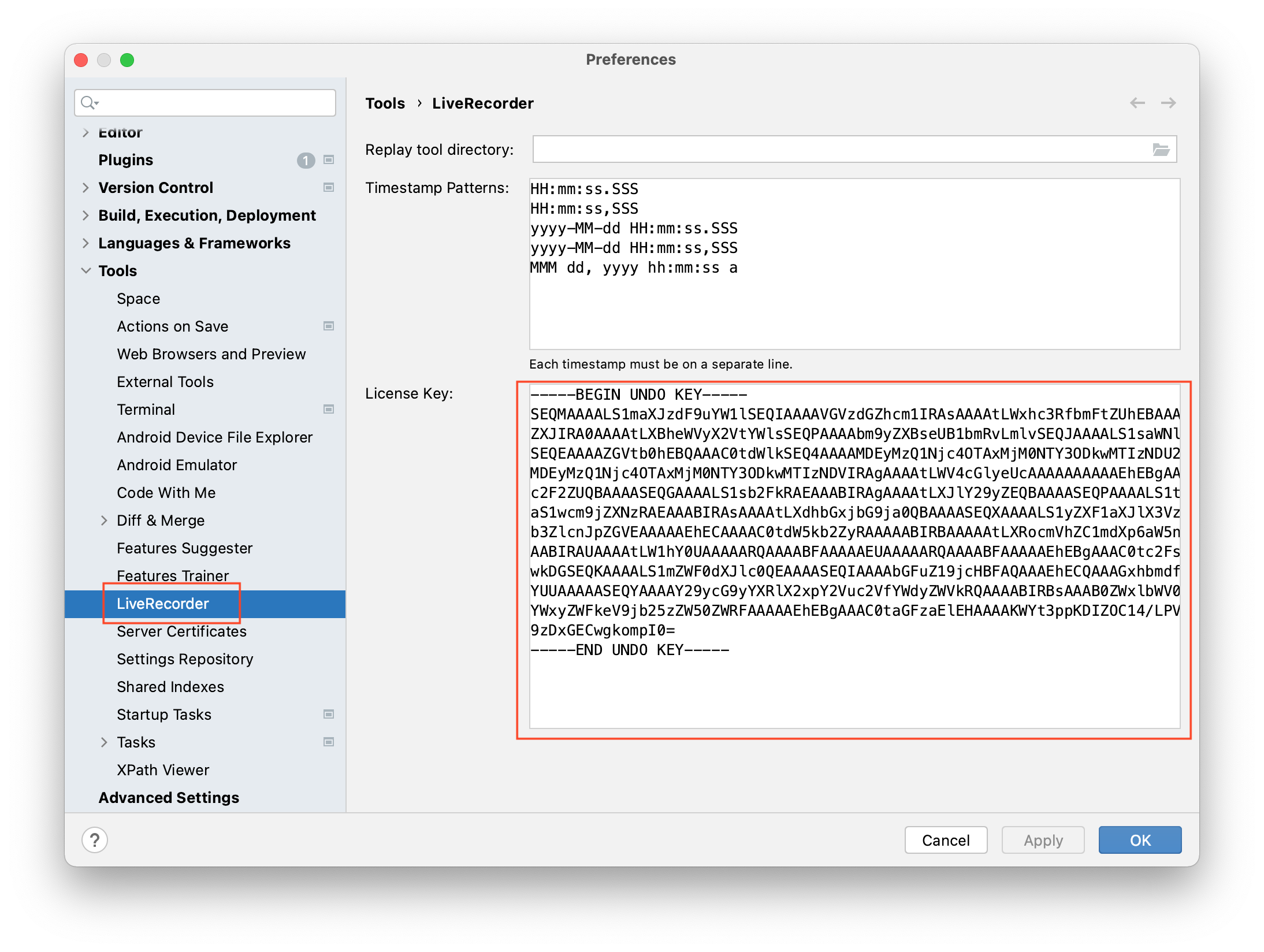
Under Settings › Tools › Undo for Java › License Key, paste your license key.